How to Adjust Light an Hour Before Bed | Prepare for Sleep Starting Tonight

You plan to go to bed at 11 PM, but until just before, your room is bright as day, and your smartphone is in your hand.
Many households experience evenings like this. You don't need to change your entire life. Just for one hour before bed, be mindful of how you use light. That alone will change how your evening ends.
This article provides a specific, step-by-step guide to adjusting the light in the hour before bed. It's a practical routine version of the concepts outlined in The Relationship Between Sleep and Light.
Why "One Hour Before Bed"?
The Ministry of Health, Labour and Welfare's "Sleep Guide for Health Promotion 2023" suggests distinguishing between light before and during sleep, and light in the morning and daytime. This is because prolonged exposure to strong light late at night can make it difficult for the body to relax before sleep.
Managing all the light throughout the day isn't realistic. However, the hour right before falling asleep is manageable. The light in your room, the light from your screen, and the light in your hand. This routine involves adjusting these three in sequence.
[60 Minutes Before] Dim the Room Lights
The first step is your overall room lighting.
Lower the brightness of your ceiling light by one or two levels and change the color to a warm, incandescent tone. If you have a dimmable and color-tunable light, it's just a remote control operation.
The key is not to dim it to the point where it's inconvenient. You still have things to do at night, like tidying up or preparing for tomorrow. The goal is to create a "transition" from daytime light to nighttime light, within a range that doesn't hinder your activities.

[45 Minutes Before] Reconsider Your Relationship with Your Smartphone
For many, completely abandoning their smartphone before bed isn't realistic. That's why we think of it not as "stopping" but as "changing the conditions."
Lower the screen brightness. Switch to a warm-toned display like Night Mode. And hold it a little further from your face. Even with the same screen, the amount of light reaching your eyes changes significantly with these adjustments.
If only a bright screen remains after dimming the room, the contrast in light becomes strong. The trick is to dim the screen light along with the room light.
[30 Minutes Before] Switch to Local Lighting
From here, we gradually phase out the need for overall room light.
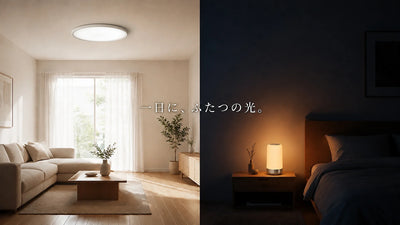
Turn off the ceiling light or dim it to a minimum, and switch to bedside lighting. If you're reading, just a local light adjusted to a readable brightness is sufficient.
The division of roles between overall room lighting and local lighting is explained in detail in How to Use Ceiling Lights and Sleep Lights.
Your entire field of vision becomes a calm darkness, with only your immediate area softly lit. This is how to create the last 30 minutes before sleep.

[15 Minutes Before – Lights Out] Only Minimal Lighting
When you close your book, dim the local light to a minimum too.
If your light has a timer or sleep mode, setting it means you won't forget to turn it off. This also eliminates the minor awakening of having to get up to turn off the light after getting into bed.
The general rule for sleeping is to make it as dark as possible. For those who often wake up in the middle of the night, use minimal lighting placed so the light source doesn't directly hit your eyes. As mentioned in How to Choose a Sleep Light, the guideline is "use before bed, then turn off or dim to a minimum when sleeping."
For the Morning: Just One Thing
The final touch of your evening routine is actually in the morning.
When you wake up, open the curtains and let the morning light into the room. The Ministry of Health, Labour and Welfare's sleep guide also states that exposure to light in the morning and daytime is important for establishing a day-night rhythm.
Dimming the light at night and basking in the light in the morning are a set. A routine is more likely to stick if you add one minute in the morning than if you just try hard at night.
Tips for Continuing: Don't Aim for Perfection
You don't need to do all four steps every night.
Even just one remote control dimming, or one screen brightness adjustment. Choosing just two things you can do tonight will change the feel of your room before bed. Lighting is a tool that doesn't require willpower. Once set, it's just a matter of pressing the same button every night.
A routine is something you implement as a system, not something you force yourself to do.
Create Your Evening Routine with lipro
Two lipro lights support this routine from a product perspective:
- Solar Ceiling Light: "Dim one level" 60 minutes before with just one remote control. Dimmable and color-tunable from 3000K to 5000K, Ra97+, flicker-free.
- Solar Sleep Light: Local light from 30 minutes before. Stepless dimming from 1-100%, 3000K incandescent color, top touch control, and a gentle fade-out sleep mode.
Lighting doesn't directly change sleep. However, creating a system of "fixed light at a fixed time" is easiest with the right tools.
Frequently Asked Questions
Q. I don't think I can do it every night. Is it still meaningful?
A. Yes, it is. A routine is more about "room settings" than frequency. Once you've created a night mode for your lighting, the light will automatically be in that mode on the days you can do it. Even if there are days you can't, the setting remains.
Q. I end up looking at my smartphone right before bed.
A. Start by just "lowering the brightness and holding it away from your face." In the next phase, decide on a place, like under a local light rather than in bed. Changing the conditions is more sustainable than prohibiting it.
Q. Is there a correct answer for how many lux should be used?
A. There isn't a single correct numerical answer, as it varies depending on room size and wall color. The guideline is your perception. If "the whole room isn't dazzling," "you can read text in your hand," and "the light source doesn't directly hit your eyes," then the nighttime lighting is sufficiently adjusted.
Summary: An Hour Divided into Four Sections
Dim the room light 60 minutes before. Adjust screen light 45 minutes before. Switch to local lighting 30 minutes before. From 15 minutes before, use minimal light. And in the morning, open the curtains.
That's all you need to remember.
Start tonight by pressing the dimming button on your remote.
References
- Ministry of Health, Labour and Welfare "Sleep Guide for Health Promotion 2023"
https://www.mhlw.go.jp/content/001305530.pdf - lipro "Solar Ceiling Light"
https://jp.lipro.com/ja-jp/products/ceiling-light-ja - lipro "Solar Sleep Light"
https://jp.lipro.com/ja-jp/products/sleep-light-ja