"Aren't LEDs too bright?" How lighting optical design solves the discomfort of direct glare

Have you ever felt that LED lighting is "somehow dazzling" or "it hurts your eyes to look directly at the light"? This is actually due to the optical design of the lighting fixture. This time, we will scientifically explain the mechanism of LED "glare" and the design technology that solves it.
Q: Why do LEDs feel "dazzling" in the first place?
Traditional incandescent and fluorescent lamps diffused light from the entire filament or fluorescent tube. Because the light source area was large and the luminance (brightness per unit area) was relatively low, the light entering the eyes was dispersed and felt gentle.
On the other hand, LEDs have the characteristics of a point light source. Since highly directional light is emitted from a chip just a few millimeters square, the luminance relative to the light source area is extremely high. As pointed out in HLLED's technical report, "LEDs tend to produce harsh glare and uncomfortable shadows without diffusion processing or beam angle control."
In simple terms, even with the same brightness, the smaller the light-emitting surface, the more "dazzling" it feels—this is a structural challenge for LEDs.
Q: Are "dazzle" and "glare (UGR)" the same thing?
This is a common point of confusion, so let's clarify.
Direct glare (disability glare / discomfort glare)
The discomfort or dazzle felt when a lighting fixture is directly in one's line of sight. It intensifies as the luminance of the light source increases. This is the "dazzle" most commonly experienced in daily life, such as when looking up at a ceiling downlight or when the light source of a desk lamp directly enters the eyes.
Glare / UGR (Unified Glare Rating)
An index defined by the Illuminating Engineering Society (IES/CIE) for quantitatively evaluating uncomfortable glare in an entire indoor lighting system. According to ERCO's technical explanation, UGR is calculated by comprehensively considering the position, luminance, and viewing angle of all lighting fixtures in a space. UGR ≤ 19 is recommended for offices, and UGR ≤ 16 for precision work.
It is important to note that these are two different issues. While the UGR value of modern lighting fixtures is generally good due to advancements in optical design, direct glare—that is, the discomfort felt when looking at a lighting fixture—remains a challenge for many products. Especially for fixtures with a wide light-emitting surface, such as ceiling lights, the method of light diffusion greatly affects comfort when viewed directly.
Q: How can direct glare be eliminated?
The key to the solution is "how the light is emitted"—that is, optical design. There are two main approaches.
Approach ①: Use a diffuser
This method involves placing a diffuser plate, such as PC (polycarbonate), in front of the LED chip to convert point light sources into surface light sources. HitLights' technical explanation states that diffusers scatter light uniformly, suppressing luminance variations and achieving soft, uniform illumination.
However, diffuser plates alone have limitations. If the diffusion is too high, light loss occurs, and if it's too low, the LED "dots" become visible.
Approach ②: Change the light emission direction itself
A more fundamental solution is a design that does not direct LED light straight down, but radiates it horizontally or upwards.
According to SFR Lighting's explanation, indirect lighting methods reflect light off the ceiling or walls before distributing it into the space, preventing direct light from entering the eyes and significantly improving visual comfort. With this method, even when looking directly at the light source, highly luminous chips do not enter the field of vision, making it less likely for uncomfortable glare to occur.
Q: What are "side-emitting" and "top-emitting"?
Most common ceiling lights adopt a direct emission method. LED chips are positioned facing downwards, and light is directly emitted towards the floor through a diffuser cover. While efficient, the chips' luminance is high even through the cover, making it a structure that easily causes "dazzle" when looked up at.
In contrast, there is a method that combines side-emitting and top-emitting.
Side-emitting: LED chips are placed sideways in the fixture, radiating light horizontally. According to Rina Technology's technical data, side-emitting methods prevent the light source from being directly exposed, creating soft, diffused light through reflection and refraction, which prevents direct light glare and improves visual comfort.
Top-emitting: Some LED chips are placed facing upwards, reflecting light off the ceiling before distributing it into the space. Following the same principle as indirect lighting, by utilizing the entire ceiling as a large light-emitting surface, extremely soft light can be achieved.
Combining these two results in:
- Significant reduction in high-luminance light directly below, so it's not dazzling when looking up
- Light is uniformly diffused throughout the room, and shadows are softer
- Reflected light from walls and ceilings becomes primary, creating an atmosphere like a room with natural light
Q: Does the quality of the spectrum also relate to "glare"?
In fact, the light spectrum (wavelength distribution) also affects how glare is perceived.
Common LEDs (blue chip + yellow phosphor method) have a sharp peak around 450nm. This high-energy blue light strongly stimulates the retina, amplifying discomfort even at the same lux (illuminance).
On the other hand, full-spectrum light (continuous distribution across all wavelengths) like sunlight does not concentrate energy at specific wavelengths, making excessive pupil constriction less likely and providing a relaxed visual experience at the same brightness.
In other words, only by optimizing both optical design (how light is emitted) and spectrum design (what the light is made of) can "truly glare-free light" be achieved.
lipro's commitment to "how light is emitted"
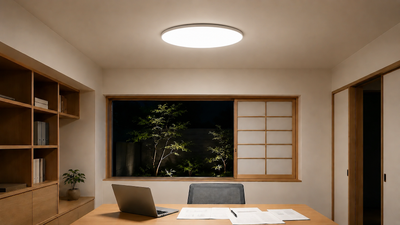
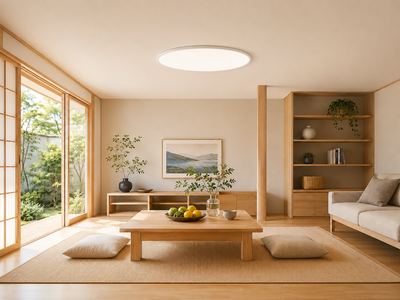
lipro's ceiling lights adopt a hybrid optical design of side-emitting + top-emitting. Instead of directing LEDs downwards, light is radiated sideways and upwards, and then diffused and reflected to softly distribute light throughout the space.
Furthermore, by combining this with a full-spectrum light source (sunlight similarity of 94.86%) based on Violet Emitting Technology, lipro addresses the root cause of "glare" from both optical design and spectrum design perspectives.
In the photobiological safety evaluation based on IEC 62471, it achieved the highest rating of RG0 (Exempt Class). This means it is "safe to use without restriction," a design that ensures safety even when children look up at the ceiling light.
Summary: "Bright yet not dazzling" can be achieved with technology
The impression that "LEDs are dazzling" is not a problem with LEDs themselves, but a problem of optical design. By optimizing how light is emitted and the quality of the spectrum, it is possible to create a comfortable lighting environment without glare while ensuring sufficient brightness.
When choosing lighting, do you only look at "how many lumens (brightness)"? Even with the same brightness, the comfort of the space changes completely depending on how the light is emitted.
Especially for lighting in spaces where you spend a lot of time, such as children's rooms or living rooms, please pay attention to "how the light is emitted" when choosing. Eye-friendly light can change the quality of life itself.
References
- ERCO. "UGR Method — Unified Glare Rating." Lighting Knowledge
- Scheir, G.H. et al. (2015). "Calculation of the Unified Glare Rating based on luminance maps." Building and Environment
- HLLED. "Do You Need A Diffuser For LEDs?" Technical Report
- HitLights. "The Power of Diffusers: Transforming Light for Enhanced Applications."
- SFR Lighting. "Direct vs Indirect LED Linear Lighting." Technical Guide
- Rina Technology. "The Difference Between Side-emitting and Straight-emitting LED Panel Lights."
- IEC 62471. "Photobiological Safety of Lamps and Lamp Systems."
💡 liproなら、この記事で紹介したすべての条件を満たしています