Proper Use of Ceiling Lights and Sleep Lights: Distinguishing Roles of Nighttime Lighting

Many people think that one ceiling light is enough for a bedroom.
Indeed, if all you want to do is brighten a room, then that's enough. However, if you look at it from the perspective of "making the night more comfortable," relying on a single light source is surprisingly impractical.
This article will clarify the roles of ceiling lights and sleep lights (bedside lighting) and introduce how to combine them according to the flow of your day.
Detailed information on how to choose each can be found in How to choose an eye-friendly ceiling light and What is a sleep light?. This article discusses how to combine these two.
Relying on one light source for everything can lead to problems
There are three common dead ends when trying to spend the night with only a ceiling light.
The entire room is bright right up until you go to bed. Light from the ceiling is meant to illuminate the entire room. If you keep it on for reading, your entire field of vision will remain bright even after you get into bed.
When you turn it off, it becomes pitch black. When you want to read a book at hand or check on your child before going to bed, you often face a choice between illuminating the entire room or plunging it into darkness.
Night lights (small bulbs) can be distracting. The night light mode on ceiling lights is convenient, but because the light source is in the center of the ceiling, it has the drawback of being easily visible when lying on your back.
This is not a product flaw, but a problem of roles. If you try to make a tool designed to illuminate an entire room also handle detailed tasks by your bedside, it will inevitably lead to difficulties.
The idea of role-sharing
Therefore, we divide nighttime lighting into two roles.
| Ceiling Light | Sleep Light | |
|---|---|---|
| Role | Overall room brightness | Lighting for hands/feet |
| Main Time | Daytime to just before sleep | Before bed to middle of the night |
| Strengths | Activity light. Visibility for chores, work, and family time. | Pre-sleep light. Reading, nursing, moving around at night. |
| Weaknesses | Illuminating only the bedside, pinpoint light at night | Brightening the entire room |
By dividing the light into two layers—overall room light and task light—you avoid getting stuck between "too bright" and "too dark."
As organized in the article on sleep and light, the combination of brightness, color, and time of day is important for nighttime light. Role-sharing is the easiest way to achieve this.

How to combine them according to the flow of the day
Dividing the time from evening to morning into five scenarios clarifies the roles of the two types of lighting.
Evening to dinner: The ceiling light is the main player. Keep the brightness as is, and shift the color slightly warmer. This maintains visibility for chores and meals.
1-2 hours before bedtime: Dim the ceiling light and switch to an incandescent color. This is when the sleep light comes into play. For reading or putting children to bed, use the bedside light.
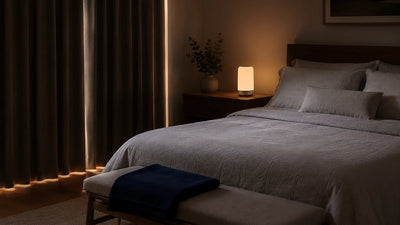
Lights out: Turn off the ceiling light. Use only the sleep light at its minimum brightness. When going to sleep, turn it off or set it to turn off automatically in sleep mode.
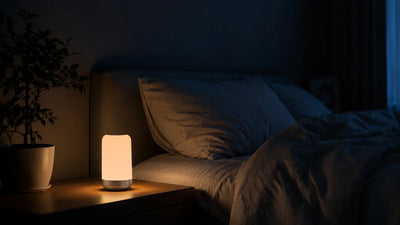
Middle of the night: If you wake up, only turn on the sleep light. By not brightening the entire room, you won't wake up your family and it's gentler on your eyes. The Ministry of Health, Labour and Welfare's sleep guidelines also state that when going to the bathroom at night, it's important to use indirect lighting or footlights to prevent falls and reduce the amount of light entering your eyes.
Morning: Switch to the ceiling light. Use a refreshing daylight white to transition to the light of a new day.

Tips for each scenario
Bedroom: This is the most basic combination. Choose a ceiling light that can be dimmed and color-adjusted, and a sleep light that can be dimmed steplessly, to ensure a smooth transition into the night.
Children's room: Use the ceiling light with an incandescent color until bedtime, then switch to a sleep light at foot level after lights out. A rechargeable light that is safe even if it falls can be placed anywhere.
Studio apartment: Precisely because it's a single room, separating time with light has a greater effect. It's the easiest way to create "different faces of the same room" for daytime and nighttime.
In the case of lipro
lipro's two types of lighting are designed with this division of roles in mind from the outset.
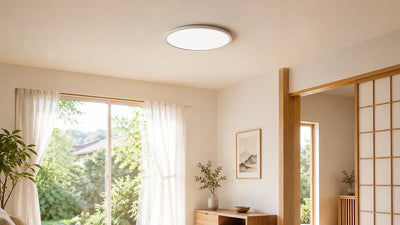
- Solar Ceiling Light: Overall room lighting. Dimmable and color-adjustable from 3000K to 5000K, for daytime activity mode to incandescent color before sleep. High color rendering of Ra97+, RG0, flicker-free. Available for 6-tatami and 8-tatami rooms.
- Solar Sleep Light: Task lighting. Stepless dimming from 1-100%, 3000K incandescent color, touch control on top surface, cordless with Type-C charging. Automatic turn-off with sleep mode.
Even with just one of these, nighttime lighting can be optimized. However, when both the overall room lighting and task lighting are available, adjusting for "not too bright, not too dark" becomes much easier. If you already use one, adding the other will expand your nighttime lighting options.
Frequently Asked Questions
Q. If I'm getting them all at once, which one should I get first?
A. If you're setting up your room's lighting from scratch, start with a ceiling light that handles the entire room. If you're already satisfied with your room's lighting but are struggling with "task lighting before bed" or "lighting in the middle of the night," adding a sleep light is a quicker solution.
Q. Do I need two even for a studio apartment?
A. It's not essential. However, in a studio apartment, where living and sleeping share the same space, being able to separate "overall room light" and "task-only light" makes it easier to transition to nighttime.
Q. Should I spend the night with a night light (small bulb) or a sleep light?
A. Generally, it's best to sleep in as dark a room as possible. For those who wake up in the middle of the night, a sleep light positioned lower than eye level is better than a ceiling night light for minimizing the amount of light entering your eyes.
Summary: Room light and task light
The ceiling light is for the whole room and active times. The sleep light is for task lighting and before-sleep times.
Instead of relying on one light for everything, divide the roles between two lights. This alone can resolve most instances of "too bright" and "too dark" at night.
For detailed selection guides, please refer to the Ceiling Light edition and Sleep Light edition. The concept of nighttime lighting is summarized in Sleep and Light.
References
- Ministry of Health, Labour and Welfare "Sleep Guide for Health Promotion 2023"
https://www.mhlw.go.jp/content/001305530.pdf - lipro "Solar Ceiling Light"
https://jp.lipro.com/ja-jp/products/ceiling-light-ja - lipro "Solar Sleep Light"
https://jp.lipro.com/ja-jp/products/sleep-light-ja