The Rhythm of Nature and Sleep | How Light Shapes Our Daily Lives

You wake up in the morning. You are active during the day. You get sleepy at night.
This natural rhythm isn't solely created by the internal clock in your body. The "light" you are exposed to every day plays a role in setting that clock.
This article will clarify the relationship between natural rhythms and light, and, by reviewing publicly available research data, will explain how to best utilize light throughout the day.
The Body's Rhythm is Regulated by Light
The human life rhythm generally operates on a 24-hour cycle. This rhythm is adjusted daily by the light you are exposed to in the morning and during the day.
The Ministry of Health, Labour and Welfare's "Sleep Guide 2023 for Health Promotion" also highlights light as a factor in creating a good sleep environment, indicating that light in the morning and daytime should be considered separately from light before bedtime and during sleep.
The International Commission on Illumination (CIE) also suggests high light exposure during the day, lower light exposure before bedtime, and a near-dark environment during sleep. While these are not values to be applied directly to households, they serve as the basis for the principle of "bright during the day, dark at night."
A Body That Has Lived Under the Sun
Imagine a day in nature.
It brightens with the morning sun, reaches peak light at noon, gradually darkens with the sunset, and at night, there's only small, warm-colored light like a flame. The human body has long lived within this rhythm.
In modern indoor environments, this rhythm tends to break down. People spend their days in rooms darker than outside, and at night, they are exposed to bright lighting and smartphone screens as if it were daytime. This "dark during the day, bright at night" reversal is a challenge in modern light environments.
Light with a Spectrum Close to Sunlight: Publicly Available Research Data
So, how does light that reproduces a spectrum close to sunlight relate to sleep?
For the sunlight spectrum-reproducing LED light sources (Powered by SunLike) used in lipro products, experimental data from university research teams are publicly available. Here, we introduce two representative examples, along with their conditions.
Research by Seoul National University College of Medicine (2018)
In 2018, a research team from Seoul National University College of Medicine conducted a clinical trial to investigate the effects of natural light spectrum LEDs on nocturnal sleep and visual comfort. They compared environments with conventional LED lighting and natural light spectrum LED lighting, monitoring multiple indicators such as visual fatigue, speed of falling asleep and waking up, heart rate during sleep, and autonomic nervous system activity in 34 healthy participants aged 20 to 49.

This research reported that participants who spent time in a natural light spectrum LED environment had approximately 1.3 times higher sleep quality scores and reduced sleep onset time by about 23% compared to those in a conventional LED environment.
Source of chart: Seoul Semiconductor "SunLike" public materials (published 2018)
Research by the University of Basel (2019, Switzerland)
In 2019, a research team led by Professor Christian Cajochen at the University of Basel in Switzerland published experimental results comparing sunlight-like spectrum LEDs and conventional LEDs in the lighting academic journal Lighting Research & Technology. They measured eye comfort, mood, waking performance, and sleep electroencephalogram (EEG) over several weeks in 15 participants aged 19 to 35.
This paper reported that delta wave activity, an indicator of deep sleep, was higher on nights when participants spent the evening under sunlight-like spectrum LED light compared to conventional LED light.

Source of chart: Cajochen, C. et al. (2019) "Effect of daylight LED on visual comfort, melatonin, mood, waking performance and sleep", Lighting Research & Technology
Cautions when interpreting data
These are reports of research conducted under specific conditions, and do not guarantee the same changes for everyone. Furthermore, lighting is not a medical device and is not intended to treat sleep-related problems.
Nevertheless, such research indicates that "the kind of light we spend our day under" is not unrelated to our daily rhythm. Therefore, it is meaningful to regulate how light is used during the day and at night.
Daytime Light: Get plenty of it to set your rhythm
The starting point for regulating your rhythm is the light in the morning and during the day.
When you wake up, open the curtains to let in the morning light. Spend as much time as possible in natural light during the day. On days when you spend a lot of time indoors, make sure to adequately brighten the room with lighting.

In a life centered around indoors, such as remote work, the quality of daytime lighting becomes important. If the light has a spectrum similar to sunlight, you can spend time indoors with a visual experience close to natural light. lipro's sunlight reproduction technology is designed for this "quality of daytime light."
Nighttime Light: Gradually dim it to prepare for sleep
From evening onwards, the role of light changes.
Gradually reduce the overall brightness of the room and change the color to a warm incandescent tone. Before going to bed, illuminate only your immediate vicinity, not the entire room. During sleep, keep it as dark as possible.

The specific methods for this flow are summarized along the timeline in How to Adjust Light in the Hour Before Bed. For information on why you should avoid strong light at night, please refer to the article on sleep and light.
What Lighting Can Do: Create an Environment
One important premise: lighting is not a medical device and is not intended to treat sleep problems.
If you have persistent insomnia or other difficulties that interfere with your daily life, you should consult a specialist instead of trying to solve it with lighting alone.
However, lighting can still play a role. It can make daytime more comfortable with light that closely resembles natural light, and make it easier to prepare for sleep at night with warm, subdued light. Lighting works every day as a tool to create "contrast between day and night light."
lipro's Philosophy on Light
lipro products are designed with the philosophy of "harmonizing with natural rhythms," and they incorporate the same type of sunlight-spectrum reproducing LED light sources as those used in the research mentioned above.
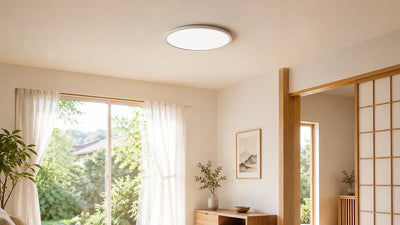
- Sunlight Ceiling Light: During the day, it provides a spectrum close to sunlight and a crisp color for active time; at night, it switches to a warm incandescent color. Features 3000K to 5000K dimming and color tuning, Ra97+, RG0, and flicker-free operation.
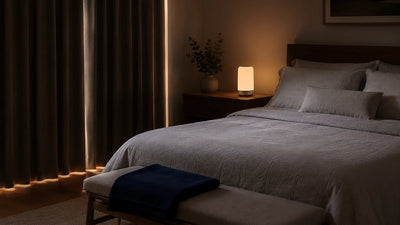
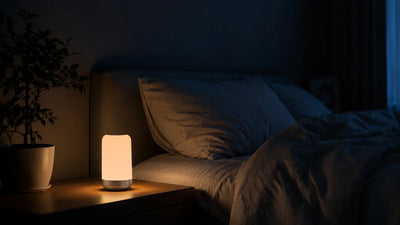
- Sunlight Sleep Light: Gently illuminates only your immediate vicinity at night with a warm 3000K incandescent color. Features 1-100% stepless dimming and a sleep mode.
Improving the quality of both daytime and nighttime light. That is the role of lighting that harmonizes with natural rhythms.
Summary: Create Contrast in Your Daily Light
In the morning, open the curtains. During the day, spend time in bright light. In the evening, switch to warm colors. At night, use only task lighting. When you sleep, keep it dark.
Most of these things you can start doing today without any special tools. And when choosing lighting, consider both "daytime quality" and "nighttime gentleness." That's how you choose lighting that works with your natural rhythm.
References
- Ministry of Health, Labour and Welfare "Sleep Guide 2023 for Health Promotion"
https://www.mhlw.go.jp/content/001305530.pdf - CIE "Position Statement on Integrative Lighting"
cie.co.at (English) - Seoul Semiconductor "SunLike" announcement of clinical trial by Seoul National University College of Medicine (2018)
businesswire.com (English) - Cajochen, C. et al. (2019) "Effect of daylight LED on visual comfort, melatonin, mood, waking performance and sleep", Lighting Research & Technology
journals.sagepub.com (English)