Children's Eyes and Light: Decoding Blue Light and Color Rendition with Research Data

The amount of time children spend interacting with smartphones, tablets, and educational devices has increased year after year. Simultaneously, they spend as much time under indoor lighting as adults do.
For children's eyes, "the type of light they spend time in" is an often-overlooked yet crucial topic. This article examines data related to children's visual environment and organizes how to choose eye-friendly lighting.
Current Status of Children's Eyesight: Data Perspective
According to the Ministry of Education, Culture, Sports, Science and Technology's "School Health Survey," the percentage of students with uncorrected visual acuity of "less than 1.0" in 2023 was 37.79% for elementary school students, 60.93% for junior high school students, and 67.80% for high school students. The percentage of children with low visual acuity increases with higher grade levels.
Various factors contribute to declining eyesight, and lighting alone cannot explain it. However, the indoor "light environment" where children spend many hours every day is one element in daily life that can be re-evaluated.
Why Children's Eyes Are More Susceptible to Light
Children's eyes have a different structure than adults'. One major difference is the transparency of the lens.
Adult lenses gradually become yellowish with age, filtering out short-wavelength light (blue light) to some extent. In contrast, children's lenses are very transparent, allowing light to reach the retina almost unfiltered.
This is why it's valuable to not only monitor device usage time but also to consider the quality of light in the entire room.
What to Look for in Lighting for Children's Rooms
Here are the points to check when choosing lighting for a child's room where they study or relax:
- Blue light safety: RG0 (risk-free) according to the IEC 62471 "RG classification" is the safest.
- Color Rendering Index (Ra): Sunlight is Ra100. If Ra is 90 or higher, preferably Ra97+, colors appear natural.
- Glare: A design where discomfort when looking directly at the light is minimal, and the light is uniform.
- Flicker: Even imperceptible flicker can lead to eye strain.
- Dimming and color temperature adjustment: Being able to change brightness and color according to the time of day allows for active use during the day and softer light at night.
Light with a Sunlight-like Spectrum: Published Research Data
For light that reproduces a spectrum similar to sunlight, experimental data from university research teams has been published. Here are two representative studies on sunlight-spectrum-reproducing LED light sources (Powered by SunLike) used in lipro products, along with their conditions.
Seoul National University College of Medicine Research (2018)
This was a controlled experiment comparing visual fatigue and light sensitivity in 34 healthy adults aged 20 to 49, under environments of conventional LED lighting and natural light spectrum LED lighting. The study reported that the group using natural light spectrum LEDs showed better indicators of eye fatigue compared to the general lighting group (the study described it as "a difference of approximately 4.3 times").
Source of figures: Seoul Semiconductor "SunLike" public materials (published 2018)
University of Basel Research (2019, Switzerland)
This study, published in the lighting academic journal Lighting Research & Technology, measured eye comfort, mood, alertness, and sleep in 15 participants aged 19 to 35 over several weeks. The paper reported that the evaluation of visual comfort was higher in the LED environment with a spectrum similar to sunlight (the study described it as "approximately 1.2 times").
Source of figures: Cajochen, C. et al. (2019) "Effect of daylight LED on visual comfort, melatonin, mood, waking performance and sleep", Lighting Research & Technology
Caution When Interpreting Data
These are reports of research conducted under specific conditions and do not guarantee the same changes for everyone. Additionally, lighting is not a medical device and is not intended for the prevention or treatment of eye problems, including myopia. If you are concerned about your eyesight or eye discomfort, please consult an ophthalmologist or other specialist.
Nevertheless, these studies suggest that "the light environment one spends time in" is not unrelated to eye comfort.
Small Ways to Improve Lighting in Children's Rooms
- For study time, make the room bright with white light (around 4000K) (lipro's "study mode" is 4000K white light). For even more brightness during the day, use daylight white (5000K).
- In the evening and at night, switch to warm incandescent color (around 3000K) for a softer light.
- Do not let children use devices in a dark room. Use them with indoor lights on.
- If a child complains of "tired eyes" or "blurry vision," review the lighting environment and consider an ophthalmologist visit.
Eye-Friendly Lighting from lipro
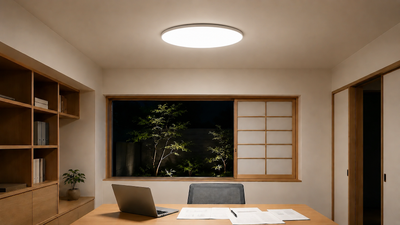
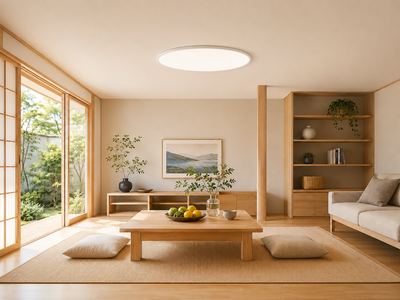
lipro's sunlight ceiling lights utilize the same type of sunlight-spectrum-reproducing LED light source as those used in the research introduced above.
- Blue light: RG0 (IEC 62471, the safest risk group)
- Color rendering: Ra97+ (natural color appearance, close to sunlight)
- Flicker-free design and dimming/color temperature adjustment from 3000K to 5000K (4000K white for studying, 3000K incandescent for before sleep)
Because it's a room where children spend every day, please pay attention to the quality of the light.
Summary
Children's eyes are said to be more susceptible to light than adults'. In addition to managing device usage time, paying attention to the quality of the light they are exposed to daily—blue light safety, color rendering, glare, and flicker—is the first step in creating a good visual environment for children.
Lighting is not a tool for preventing or treating myopia. However, creating an eye-friendly light environment is something that can be done at home starting today.
References
- Ministry of Education, Culture, Sports, Science and Technology "School Health Survey" (2023)
- Seoul Semiconductor "SunLike" public materials (Clinical trial by Seoul National University College of Medicine, 2018)
businesswire.com (English) - Cajochen, C. et al. (2019) "Effect of daylight LED on visual comfort, melatonin, mood, waking performance and sleep", Lighting Research & Technology
journals.sagepub.com (English)
💡 liproなら、この記事で紹介したすべての条件を満たしています