Learning and Light | Understanding Lighting for a Productive Space Through Research Data

Have you ever considered the "lighting" around your desk when you want to concentrate on studying or working?
Light is believed to affect not only visibility but also how we spend our daytime hours. This article will explore the relationship between light and learning, reviewing publicly available research data and offering tips for optimizing your room's lighting to enhance concentration.
Daytime Light and How We Spend Our Day
Humans have historically spent their days actively under the sun. Receiving ample light from morning to daytime serves as the starting point for our daily rhythm.
The Ministry of Health, Labour and Welfare's "Sleep Guidelines for Health Promotion 2023" also suggests differentiating between morning/daytime light and nighttime light. How we spend our daytime hours under different lighting conditions is subtly linked to our sleep at night and our condition the following day.
For remote work and study, where much time is spent indoors, it is worthwhile to consider the quality of daytime lighting.
Light with a Spectrum Similar to Sunlight: Publicly Available Research Data
Research data on light that replicates a spectrum similar to sunlight has been published by university research teams. Here, we introduce two representative studies on sunlight-spectrum replicating LED light sources (Powered by SunLike) used in lipro products, along with their conditions.
Harvard Medical School Study (2021)
This study focused on the relationship between lighting and cognitive function. 39 university students were asked to perform tasks under both regular LED lighting and natural-spectrum lighting, and their performance was compared. The study reported that performance metrics for task accuracy and speed were better in the natural-spectrum lighting environment (the study indicated a difference of "approximately 5%" in accuracy and "approximately 3.2 times" in speed).
Figure/Table Source: Seoul Semiconductor "SunLike" Public Data (Harvard Medical School Study, published 2021)
University of Basel Study (2019, Switzerland)
This study, published in the academic journal Lighting Research & Technology, involved 15 participants aged 19 to 35. It measured their ocular comfort, mood, and daytime alertness. The study reported that participants who spent their daytime hours in an LED environment with a spectrum similar to sunlight experienced less drowsiness and higher alertness compared to those under regular LED lighting.
Figure/Table Source: Cajochen, C. et al. (2019) "Effect of daylight LED on visual comfort, melatonin, mood, waking performance and sleep", Lighting Research & Technology
Caveats when interpreting data
These are reports of studies conducted under specific conditions and do not guarantee the same changes for everyone. Furthermore, lighting is not a medical device and does not promise effects on academic performance or health.
Nevertheless, such research indicates that "how one spends their daytime under light" is not unrelated to ease of concentration and visibility.
Tips for Adjusting Room Lighting for Better Concentration
- For study/work, illuminate the entire room brightly with white light (around 4000K) (lipro's "Study Mode" is 4000K white. For more brightness, 5000K daylight white is also available).
- Be mindful of how light falls to prevent shadows on your desk, ensuring your hands are not dark.
- Choosing uniform light with minimal glare helps reduce eye strain.
- From evening onwards, switch to warm incandescent light (around 3000K) to prepare for the night.
- Being able to adjust brightness and color temperature makes it easy to switch between focus during the day and relaxation at night.
More details on adjusting nighttime lighting can be found in Adjusting Light for the Hour Before Bed, and on daily light rhythm in Natural Rhythm and Sleep.
lipro's Daytime Light
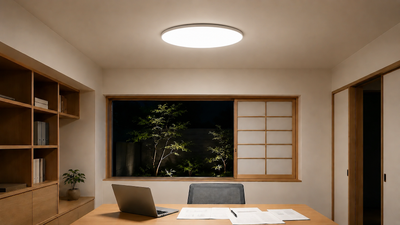
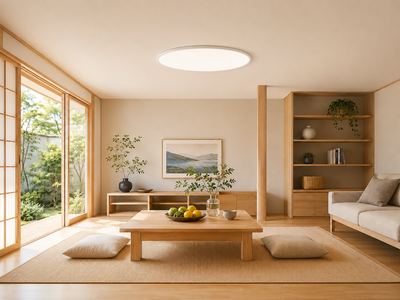
lipro's sunlight ceiling light uses the same type of sunlight-spectrum replicating LED light source as those used in the studies mentioned above.
- Switch between white light for studying (4000K "Study Mode") and incandescent light for evening (3000K), with a spectrum similar to sunlight.
- Color rendering Ra97+ / Blue light RG0 / Flicker-free design.
- 3000K to 5000K dimming and color adjustment for focus during the day and subdued light at night.
Summary
Light is not just for visibility. How one spends their daytime under light is subtly linked to ease of concentration and daily rhythm.
It cannot be definitively stated that lighting improves academic performance. However, making light distinct—bright and clear during the day, warm and subdued at night—is a practical way to improve your learning environment starting today.
References
- Ministry of Health, Labour and Welfare "Sleep Guidelines for Health Promotion 2023"
https://www.mhlw.go.jp/content/001305530.pdf - Seoul Semiconductor "SunLike" Public Data (Harvard Medical School Study, 2021)
businesswire.com (English) - Cajochen, C. et al. (2019) "Effect of daylight LED on visual comfort, melatonin, mood, waking performance and sleep", Lighting Research & Technology
journals.sagepub.com (English)
💡 liproなら、この記事で紹介したすべての条件を満たしています