Sleep and Light | Lighting Concepts to Optimize Your Pre-Sleep Environment

Nighttime lighting isn't just about making things dark.
There's the time we spend looking at our smartphones before bed, the time we read a book by our bedside, and the time we get up in the middle of the night and just want a little light at our feet. We spend time in various kinds of light right up until we fall asleep.
Light isn't just for brightening a room. There are different ways to use light for morning, afternoon, and night.
This article organizes the relationship between sleep and light without relying too heavily on technical terms. While lighting cannot directly solve sleep problems, you can review your light environment to make the time before bed more comfortable.
Why are sleep and light related?
People's daily rhythms are influenced by light.
Exposure to outdoor light in the morning triggers activity. Spending time in bright light during the day is also important for establishing a day-night rhythm. Conversely, prolonged exposure to strong light late into the night can make it difficult for your body to relax before sleep.
The Ministry of Health, Labour and Welfare's "Sleep Guide for Health Promotion 2023" also addresses light, temperature, sound, and other factors as important for creating an environment conducive to good sleep. Regarding light in particular, it suggests considering morning and daytime light separately from light before and during sleep.
What's important here is that it's not simply a matter of "the darker the better at night." There are times before bed when you need light, such as for reading, tidying up, breastfeeding, or moving around at night. Therefore, it's crucial to think about using light that isn't too strong, only where and when it's needed.
As introduced in "What is Healthy Light? A New Approach to Lighting for Eyes, Sleep, and Daily Life," healthy light is not about promising medical effects, but rather about creating a light environment that suits your daily life. Thinking about sleep and light as part of this makes it easier to understand.
Brightness, Wavelength, and Time of Day are Key
When considering light before bed, blue light often comes up in conversation.
Indeed, the Ministry of Health, Labour and Welfare's sleep guide explains that short-wavelength light, which includes blue light, and strong light can affect the body's internal clock. However, it's not just blue light that you need to be wary of.
The three main factors to consider for nighttime light are:
- Brightness
- Wavelength
- Time of day

For example, even warm-colored light can be too intense for sleep if it's too bright or if you stare at it close to your face for a long time. Conversely, it's not appropriate to label light as "good for health" or "good for sleep" based solely on its color.
The International Commission on Illumination (CIE) also states that when considering the health effects of light, it's necessary to consider the amount of light, spectrum, and time of day, not just the color temperature.
In other words, for lighting before bed, it's important to look not only at whether it's "warm-colored," but also "how bright it is," "from what direction it enters the eyes," and "when it's used."
Daytime light and nighttime light have different roles
Light doesn't play the same role throughout the day.
In the morning and during the day, try to get as much natural light as possible. Maintain good visibility during work and study hours. Gradually switch to a calmer light from evening to night. And when you sleep, keep the environment as dark as possible.

By changing the role of light according to the time of day, it becomes easier to manage your nighttime routine.
The CIE's 2024 Position Statement also suggests a concept of high light exposure during the day, lower light exposure for three hours before bedtime, and a near-dark environment during sleep. While this isn't a direct numerical application for home lighting, it serves as a useful reference for thinking about the direction of "separating light for day and night."
You don't need to perfectly manage everything inside your home. Start by not leaving the ceiling lights on at maximum brightness late into the night. Avoid looking at your smartphone close to your face for extended periods before bed. Gently illuminate only your hands or feet when needed.
Even small adjustments can change how you experience nighttime.
4 things to review in your room before sleep
1. Don't leave ceiling lights on
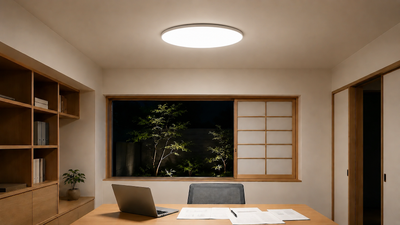
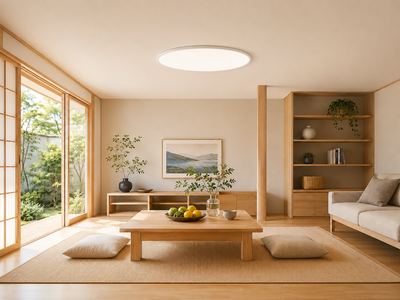
Ceiling lights are designed to illuminate an entire room. While convenient for spending time in the living room or bedroom, continuously using them at high brightness right before bed can make the light feel too strong for nighttime.
If you have dimmable lighting, lower the brightness at night. Before bed, illuminate only the necessary areas instead of the entire room. Making such transitions easy can help create a better environment for sleep.
The appearance and glare of ceiling lights are discussed in more detail in the related article "How to Choose an Eye-Friendly Ceiling Light."
2. Don't expose yourself to strong smartphone light too closely
Using a smartphone before bed is a habit that many people find difficult to completely eliminate.
Therefore, realistically, instead of just "to use or not to use," it's important to review "how close you look at it," "how bright it is," and "until what time you look at it."
The Ministry of Health, Labour and Welfare's sleep guide states that not bringing smartphones or tablets into the bedroom and sleeping in as dark an environment as possible contributes to good sleep. If it's difficult to change everything at once, you can start by lowering screen brightness, holding the phone a little further from your face, or reducing checking notifications right before bed.
3. At the bedside, illuminate only the necessary areas.
Reading a book before bed. Checking on a child. Breastfeeding. Waking up in the middle of the night.
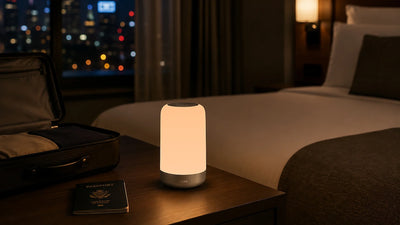
In these situations, it's often more convenient to softly illuminate only the necessary areas rather than brightening the entire room.
For bedside lighting, it's important that it's not too bright, that the light source doesn't directly hit your eyes, and that you can see your hands and feet. Too dim can make it unsafe to move around, but too strong light can also be a burden before sleep. The idea of providing the necessary brightness in the necessary direction is helpful.
4. If you wake up at night, consider safety at your feet.
Going to the bathroom at night, checking on a child, getting a drink of water. In such situations, complete darkness can be unsettling.
The Ministry of Health, Labour and Welfare's sleep guide also states that for elderly individuals going to the toilet at night, it's crucial to use indirect lighting or footlights to prevent falls and reduce the amount of light entering the eyes.
Nighttime lighting isn't just about making it dark. It's important to consider both sufficient brightness for safe movement and consideration for the pre-sleep environment when choosing bedroom lighting.
What lighting can and cannot do
Lighting is not a direct treatment for sleep problems.
If you experience persistent insomnia, strong daytime sleepiness, or your daily life is affected, it's important not to try to solve it with lighting alone, but to consult a specialist. The Ministry of Health, Labour and Welfare's e-Health Net also explains that specialized knowledge is required for sleep-related problems such as circadian rhythm sleep-wake disorders.
On the other hand, there are things lighting can do to create an environment for daily pre-sleep routines.
- Avoid excessive exposure to strong light late at night.
- Slightly dim the overall room brightness.
- Avoid continuously looking at strong smartphone light up close.
- Softly illuminate only the necessary areas.
- Maintain as much darkness as possible during sleep.
Lighting is not a magic solution that directly changes sleep. However, it can contribute to creating an environment that makes nighttime more comfortable.
lipro's concept of easy-to-use nighttime lighting
Before bed, there are situations where soft light that illuminates only the necessary areas is more convenient than brightly lighting the entire room.
lipro Sunlight Sleep Light is a small, rechargeable light that is easy to use at night for bedside, reading, breastfeeding, and moving around. Its product specifications include a warm 3000K incandescent color, 1-100% stepless dimming, Type-C charging, Ra97+, RG0, and flicker-free design.
What's important here is not to claim that this light alone will solve all nighttime problems.
At night, you want to avoid overly strong light, but you still need sufficient brightness for your hands and feet. In such situations, an adjustable and portable light can be an option for creating a comfortable pre-sleep environment.
First, review what kind of light you are exposed to in the hour before bed. Your ceiling lights, smartphone, bedside light. Making small adjustments to the light you use every day is the first step towards improving your nighttime routine.
Summary: Nighttime light can be gradually adjusted
The relationship between sleep and light is not as simple as "the darker the better" or "warm colors are always good."
It's important to consider brightness, wavelength, time of day, and how light enters your eyes, all together. Get light in the morning and during the day, avoid strong light at night, and keep it as dark as possible during sleep. Softly illuminate only your hands or feet when needed.
Lighting is not a medical device and does not directly treat sleep problems. However, it can help create a more comfortable light environment for the time before you sleep.
A small adjustment to your nighttime lighting.
That's a practical and manageable first step to creating a better environment for sleep in your daily life.
References
- Ministry of Health, Labour and Welfare "Sleep Guide for Health Promotion 2023"
- Ministry of Health, Labour and Welfare e-Health Net "Circadian Rhythm Sleep-Wake Disorder"
- CIE "CIE Position Statement on Integrative Lighting - Recommending Proper Light at the Proper Time, 3rd Edition"
- lipro "Sunlight Sleep Light"