What is a Sleep Light? Differences from Night Lights and Choosing the Right One

I want a small light in the bedroom.
When you start looking, you'll encounter various similar terms: night light, pilot light, bedside light, footlight. It can be confusing to understand the differences.
This article first clarifies the types of small lights used in a bedroom at night. Then, it summarizes 5 key points to consider when choosing one and introduces how to think about specific scenarios such as reading, breastfeeding, and moving around at night.
This content is a practical application of the concepts introduced in What is Healthy Light? and The Relationship Between Sleep and Light.
What is a Sleep Light?
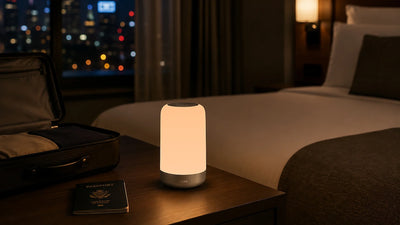
A sleep light is a small bedside light designed for the time before sleep.
It's not a light to illuminate the entire room. It provides the minimum necessary light for activities before bed, such as reading, putting children to sleep, or for hands and feet when waking up at night. It covers the period until you fall asleep and the minimal light needed during the night.
The term "sleep light" is not yet a widely established classification. At lipro, we call our rechargeable bedside lights Solar Sleep Lights, but products sold as night lights or bedside lamps in the market often serve a similar purpose.
What's important is not the name, but clearly defining "when, where, and for what purpose you will use the light" to suit your lifestyle.
Please note that lighting is not a medical device. It does not cure sleep problems; rather, it is a tool for creating a conducive environment before sleep. This premise applies throughout this article.
Differences Between Night Light, Pilot Light, and Bedside Light
Let's clarify the roles of the four commonly confused terms.
| Term | Main Purpose | Duration of Use | Common Locations |
|---|---|---|---|
| Pilot Light | Minimum light left on during sleep | Throughout sleep | Ceiling light bulb, directly plugged into outlet |
| Night Light | Auxiliary light to aid movement at night | Only when needed | Hallway, stairs, floor level |
| Bedside Light | Light used by the bedside. Also for reading and breastfeeding. | Before and after sleep | On the nightstand |
| Sleep Light | Bedside light specifically designed for creating a sleep-friendly environment | From before sleep until during the night | On the nightstand |
In practice, these boundaries are often blurred. Some people place a night light by their bed, while others use a bedside light as a pilot light substitute.
Therefore, instead of choosing based on the product name, we recommend selecting based on the following 5 points.

5 Tips for Choosing a Light for Before Sleep
1. How dim can it get?
When choosing a light for before sleep, what's more important than the maximum brightness is how dim it can get.
As organized in the article on sleep and light, continuous exposure to strong light late at night can make it feel difficult for the body to relax before sleep. It's convenient if a single unit can adjust from a brightness suitable for reading down to a minimal pilot light level.
A good indicator is whether it offers stepless dimming. If the steps are too coarse, you often find yourself stuck between "a little too bright" and "too dark to see."
2. Choose a warm, incandescent light color.
For the time before sleep, a warm, incandescent light color around 3000K is suitable.
However, it's not determined by color alone. Even incandescent light, if too bright or if stared at for a long time close to the face, can be too strong for a night light. It's important to consider the color, brightness, and time of use together.
3. Does the light source directly enter your eyes?
When lying down, if the light source directly enters your eyes, it can feel brighter than its measured lumen value.
Consider whether the entire shade glows softly, or if the design makes the light source difficult to see from a lying position. These are points you'll want to check in stores or through review photos. Additionally, a design that suppresses flicker is also suitable for long periods of nighttime use.
4. Power supply method and freedom of placement
There are three main power supply methods: direct plug-in, USB power, and rechargeable cordless.
If the placement is fixed, a plug-in type is fine. If you need to carry the light around for activities like breastfeeding, checking on children, or moving around at night, a rechargeable cordless type is convenient. You can carry it from the bedroom to the hallway.
5. Can you operate it without fumbling in the dark?
For a light used at night, ease of operation directly translates to usability.
Fumbling for a small button in the dark is an act that can wake you up. Consider if it's a touch-sensitive type that turns on by simply touching the top surface. Is the switch in an identifiable position by feel? Does it have a mode that automatically turns off after a certain period? Before buying, imagine your movements at night and verify these points.

Considerations by Scene
Reading before bed: Just enough brightness to read by is sufficient. The overall room should remain dim, with the light only illuminating the pages. Fine-tuned brightness adjustment makes it easier to match the light to your book.
Breastfeeding / Baby care: Brightening the entire room can make both the baby and yourself more awake. Softly illuminate only the necessary area. Being able to operate it with one hand and its portability are helpful features.
Going to the restroom at night: The Ministry of Health, Labour and Welfare's sleep guide also states that for nighttime bathroom trips, it is important to use indirect lighting or footlights to prevent falls and reduce the amount of light entering the eyes. Use a minimal light at a lower height than eye level to illuminate your path.
Children's room: Prioritize not being too bright, being safe if it falls, and having light that doesn't directly enter the eyes.
During sleep: The basic principle is to sleep in as dark a room as possible. If a pilot light is left on, it's important to keep the brightness to a minimum and place the light source where it doesn't directly enter the eyes.
In the case of lipro Solar Sleep Light
Applying the 5 points above to the lipro Solar Sleep Light, here's how it measures up:
- Brightness: 1-100% stepless dimming. Adjustable from reading light to pilot light level with one unit.
- Light color: Warm 3000K incandescent color. High color rendering with Ra97+ to show the true colors of the room at night.
- Glare: The entire shade glows softly, designed to prevent the light source from directly entering the eyes. Flicker-free, blue light safety is RG0 certified.
- Placement: Cordless with Type-C charging. Portable from bedside to hallway.
- Operation: Touch the top for on/off and dimming. Sleep mode gently dims and turns off automatically after a set time.
We don't claim this single light will eliminate all your nighttime concerns. However, we have designed it by carefully verifying each condition essential for a pre-sleep light: "how dim can it get," "is it glare-free," and "can it be operated without fumbling in the dark."
Detailed specifications can be found on the product page.
Frequently Asked Questions
Q. When sleeping, is it better to have complete darkness or a pilot light?
A. The Ministry of Health, Labour and Welfare's sleep guide suggests that keeping the bedroom as dark as possible leads to better sleep. However, for those who frequently wake up at night or have elderly family members, a minimal light to prevent falls can be helpful. The basic idea is to "use it before bed, and either turn it off or dim it to a minimum when sleeping."
Q. Can I leave it on all night?
A. If you leave it on, keep the brightness to a minimum and position the light source where it doesn't directly enter your eyes. If there's a timer or a sleep mode for automatic shut-off, using that is a practical option.
Q. Can it be used in a child's room?
A. Yes, it can. When choosing, prioritize that it's not too bright, safe if it falls (doesn't get hot or break easily), and the light source doesn't directly enter the eyes. It's also suitable for illuminating the path after putting children to bed until you leave the room.
Q. Should I buy a night light or a sleep light?
A. Choose based on your purpose. If your goal is safety for movement in hallways or stairs, a stationary footlight or night light is suitable. If the purpose is for bedside time before sleep, a sleep light or bedside light with dimming capabilities and easy bedside operation is recommended.
Summary: Choose by Usage Scenario, Not by Name
Night light, pilot light, bedside light, sleep light. The names may vary, but the key points to look for are the same.
How dim can it get? Is the color warm? Does the light source enter your eyes? Is the placement flexible? Can it be operated without fumbling in the dark?
Applying these 5 points to your nightly routine will make choosing a bedroom light much simpler.
A light is a tool for creating a sleep-friendly environment. For overall room lighting, refer to How to choose an eye-friendly ceiling light, and for the relationship between sleep and light, see this article. Please check them out as well.
References
- Ministry of Health, Labour and Welfare "Sleep Guide for Health Promotion 2023"
https://www.mhlw.go.jp/content/001305530.pdf - lipro "Solar Sleep Light"
https://jp.lipro.com/ja-jp/products/sleep-light-ja