How to Choose an Eye-Friendly Ceiling Light: Considering Glare, Color Temperature, and Color Rendering

Ceiling lights are used for long periods of time in homes, from living rooms and bedrooms to children's rooms and home offices. While they are a convenient way to brighten an entire room, because they are a light source we interact with daily, depending on how they are chosen, they can feel "too white," "glaring," or "cause eye strain after prolonged use."
When choosing lighting, many people first look at brightness, price, energy efficiency, and design. Of course, these are all important. However, if you want to choose an eye-friendly ceiling light, you should consider not only brightness but also light distribution, flicker reduction, color temperature, color rendering, and how it will be used in the room.
This article will organize the criteria for choosing an eye-friendly ceiling light in a way that is easy to check at the time of purchase, without relying too heavily on technical terms.
What is an eye-friendly ceiling light?
Here, "eye-friendly" does not mean that darker is better. It refers to lighting that maintains the necessary brightness while also considering glare, flicker, color appearance, and ease of use according to the time of day.
If a room is too dark, reading or working can actually cause more eye strain. On the other hand, excessively bright light or lighting where the light source easily enters the eyes directly can also lead to discomfort during prolonged use.
The important thing is not to dim the brightness, but to illuminate the entire room to make it easy to see, while minimizing the irritation to the eyes. This connects to the perspective of considering a healthy light environment, which was introduced in the previous article, "What is Healthy Light? A New Approach to Lighting for Eyes, Sleep, and Lifestyle."
When purchasing, checking the following five points will help you make a decision:
- Does the light prevent strong direct glare?
- Is it designed to reduce flicker?
- Can the color temperature be changed between day and night?
- Do colors appear natural?
- Is it suitable for the room's size and intended use?

Selection Tip 1 | Choose a light distribution that minimizes glare
The first thing to check is how the light is distributed. Since a ceiling light illuminates the entire room from above, if the light source is too strongly visible or if the light is concentrated in a specific direction, it can easily feel glaring.
To choose lighting that is "bright yet less glaring," it's crucial whether the design gently spreads the light. The feeling of brightness can change even with the same lumen output, depending on the diffusion of the cover, the placement of the light source, and how the light reflects off the ceiling and walls.
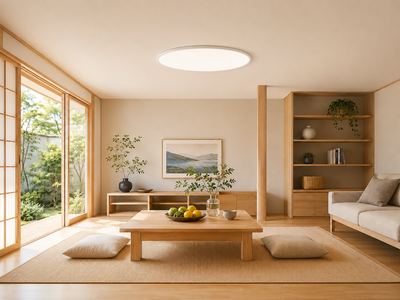
Whether relaxing in the living room, a child reading on the floor, or working from home and looking at a screen for a long time, it's more comfortable if the light spreads naturally throughout the space rather than the light source itself being strongly visible.
When purchasing, check if the cover is designed to diffuse light, if the light source is not too directly visible, and if the product description mentions glare reduction measures or optical design. If you want to know more about LED glare, the related article "Optical Design to Reduce LED Glare" is also helpful.
Selection Tip 2 | Look for designs that reduce flicker
Next, you'll want to check for flicker reduction. Lighting flicker can sometimes be clearly visible to the eye, while at other times it may be imperceptible.
In rooms where you spend a lot of time reading, studying, working on a PC, or looking at a smartphone, stable light is essential. Especially in children's rooms or offices, it's important to consider not just brightness, but whether the light causes little discomfort during prolonged use.
When purchasing, check if the product description clearly states "flicker-free" or similar, indicating a design that addresses flicker. You don't need to understand every technical detail, but it's a point you don't want to overlook for main lighting that will be used for long periods.
Selection Tip 3 | Choose models with adjustable color temperature
Ceiling lights require different types of light in the morning, afternoon, and evening. While crisp, bright light is convenient for daytime tasks, for relaxing in the evening, a calm, warmer light might be more suitable than intense white light.
This color of light is expressed by color temperature. The value is given in K (Kelvin); generally, a lower number indicates a warmer light, while a higher number indicates a whiter, crisper light. The Japan Lighting Manufacturers Association also explains that light colors are categorized by correlated color temperature.
For example, being able to adjust the color temperature to suit the time of day and activity – such as a whiter light for morning preparations or working from home, and a warmer light for evening meals or before bed – can greatly enhance the usability of the same room.
When choosing an eye-friendly ceiling light, check not only the brightness but also whether the color temperature can be adjusted. On the product page, it's easy to judge by looking at the adjustable color temperature range (e.g., from X K to Y K) and whether it can be easily switched with a remote control or app.
Selection Tip 4 | Choose lighting with high color rendering that makes colors appear natural
The colors you see under lighting change depending on the quality of the light. Food on the dining table, wooden furniture, clothes, skin tones, children's educational materials, and picture books—there are many colors in daily life that we want to appear natural.
One helpful indicator when considering how colors appear is color rendering. Generally, the higher the Ra value, the more likely colors are to appear similar to how they would under a reference light source.
However, simply looking at the numerical value is not enough. In real life, the balance of color components included in the light, the smoothness of the spectrum, and compatibility with the room's interior and furniture are also involved. That's why color rendering should not be viewed as merely a "feature for beautiful appearance," but as an important criterion for experiencing the colors of daily life naturally.
When purchasing, check the Ra value and descriptions like "high color rendering." If you want to learn more about color rendering, the related article "Ra97 and Color Appearance" explains it in detail.
Selection Tip 5 | Choose brightness that matches the room size and use
When choosing eye-friendly lighting, it's not okay to disregard brightness. The important thing is not to think that the brighter the better, but to choose a brightness that matches the size and use of the room.
Ceiling lights have目安 (meyasu), or guidelines, for room sizes such as 6-tatami or 8-tatami mats. First, choose one that matches the room's size, and then check if it is dimmable.
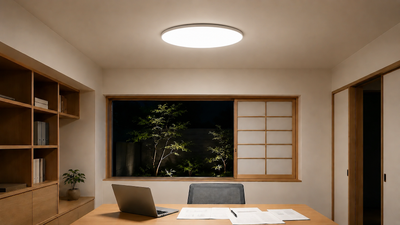
Even in the same living room, the required brightness changes for dining, reading, watching movies, or relaxing with family. In a bedroom, there are times when you want to reduce brightness, and in a child's room, good visibility for hands is necessary when studying. For working from home, it's important to consider the combination of overall room brightness and clear visibility around the desk.
The Japan Lighting Manufacturers Association's Q&A also suggests combining overall room lighting with localized lighting, such as a desk lamp, in a study room. It's necessary to have a perspective that light should be adjusted to suit one's lifestyle, rather than relying solely on main lighting for everything.

What are you likely to overlook if you only choose based on brightness and price?
When choosing a ceiling light, "what tatami size," "how many lumens," and "what is the price" are easy criteria. However, if you only choose based on these, you might notice discomfort once you start using it in your daily life.
For example, it might be bright enough but feel glaring. It might look white and clear, but uncomfortable at night. Even if the price is reasonable, food or wood grain colors might appear slightly unnatural. These discomforts are difficult to judge by brightness alone.

That's why it's important to consider the following five points together when choosing a ceiling light:
- Light distribution that minimizes glare
- Flicker reduction
- Color temperature adjustable to different times of day
- Color rendering that makes colors appear natural
- Brightness suitable for room size and use
What lipro Sunlight Ceiling Lights can do
lipro Sunlight Ceiling Lights are designed with a focus on not only brightness but also the quality of light we interact with daily.
For glare reduction, they are designed to spread light gently throughout the room. For flicker reduction, they feature a flicker-free design. For color appearance, they have a light design aiming for a spectrum close to sunlight and a high color rendering of Ra97+. In terms of safety, they have an RG0 photobiological safety evaluation. They aim to provide light that is easy to use daily at home, following the selection criteria introduced earlier.
Furthermore, with stepless dimming from 3000K to 5000K and dimming from 1% to 100%, you can adjust the light to suit morning activities, daytime work, and calm evening hours. Types are available for 6-tatami and 8-tatami rooms, and the ability to install them on existing hanging ceilings is also a convenient feature for home use.
Lighting itself is not a solution to eye or sleep problems. What is important is to re-evaluate your daily lighting environment and choose lighting that suits your room and lifestyle. As one such option, lipro offers light that considers eye strain and natural appearance.
You can learn more about lipro's light design in "Sunlight Reproduction Technology." If you want to check product specifications or compatible room sizes, please see "lipro Sunlight Ceiling Light."

Summary | Choose a ceiling light based on the quality of light you live with daily
When choosing an eye-friendly ceiling light, it's important to consider not only brightness and price but also the quality of the light.
By looking at all of these together—light distribution that minimizes glare, flicker reduction, color temperature adjustable to different times of day, color rendering that makes colors appear natural, and brightness suitable for the room's size and use—you can more easily optimize the lighting environment in your room, where you spend every day.
Lighting is not just equipment to brighten a room. It accompanies the rhythm of daily life, from reading, eating, studying, and working to relaxing and pre-sleep hours.
Bring eye-friendly light into your daily room. Choose a ceiling light that considers not only brightness but also the quality of light.
If you want to specifically check light that suits your lifestyle, please see lipro Sunlight Ceiling Light.
Learn More
- What is Healthy Light?
- lipro's Sunlight Reproduction Technology
- lipro Sunlight Ceiling Light
- Optical Design to Reduce LED Glare
- Ra97 and Color Appearance
- Correctly Understanding Blue Light from LED Lighting
References
💡 liproなら、この記事で紹介したすべての条件を満たしています